The Royal Canadian Geographical Society, in partnership with Woods Hole Oceanographic Institution, will undertake “once-in-a-generation” expedition to survey Sir Ernest Shackleton’s QUEST and Captain Robert Falcon Scott’s TERRA NOVA
OTTAWA July 1, 2026 – The Royal Canadian Geographical Society (RCGS), in partnership with the Woods Hole Oceanographic Institution (WHOI), will embark on a “once-in-a-generation” expedition this month to survey the last ships of two of the most important explorers of the Heroic Age of Antarctic Exploration, Sir Ernest Shackleton and Captain Robert Falcon Scott.
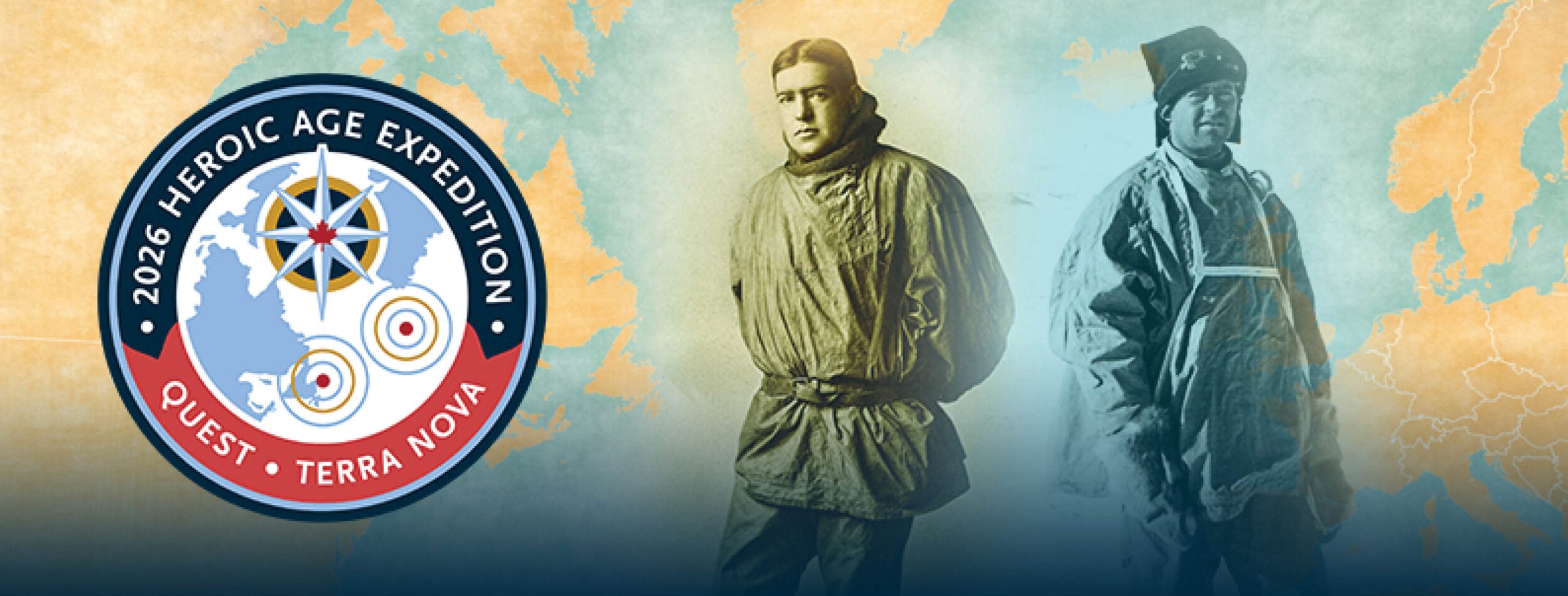
The two ships, Quest and Terra Nova, represent the last link to Shackleton and Scott, two legendary polar explorers, with vastly different leadership styles. The explorers were colleagues, then rivals who competed to reach the South Pole in the early 1900s, before each died during an expedition. They are leading figures of the Heroic Age of Antarctic Exploration, before the introduction of modern mechanical transportation and communication technologies.
This summer’s expedition will undertake the first comprehensive visual survey of both Quest and Terra Nova, producing digital twins of the wrecks by documenting and mapping the shipwrecks and debris fields around their hulls using a combination of high-definition 5.2K video cameras and through Canadian VOYIS photogrammetric technology.
The research vessel Atlantis, operated by WHOI, is the mother ship of the human occupied vehicle (HOV) Alvin and a remotely operated vehicle (ROV). The use of Atlantis and Alvin on this ambitious project is a novel example of a partnership with an educational society like the RCGS, and builds on WHOI’s expertise in the forensic investigation of deep ocean shipwrecks like Titanic. Alvin was the first submersible to ever survey Titanic.
Quest, the ship that Shackleton died on in 1922, was first discovered in 2024 by the Royal Canadian Geographical Society and Expedition Leader John Geiger in the Labrador Sea after meticulous research and historical fact finding through Canada, the United Kingdom and Norway.
Terra Nova, Scott’s final ship was first discovered by the Schmidt Ocean Institute in 2012, which is supporting this research. Both ships had ties to Canada, with Quest purchased by Shackleton for a Canadian Arctic expedition that was later aborted, before working as a sealer off Newfoundland and Labrador. Terra Nova was built in Dundee, Scotland, but was based in St.
John’s where it later served as a sealer and cargo vessel.
The expedition will mark the first time that people have visited the wreck of Quest, and seen it with their own eyes. It will be only the second time that a submersible has reached Terra Nova.
Neither ship has been previously surveyed through VOYIS technology that will create ‘digital twins’ of the wrecks.
“The discovery of Quest in 2024 was only the beginning” said John Geiger, Expedition Leader and CEO of the RCGS. On Canada Day, we will gather to embark on the largest and most ambitious expedition in the 96-year history of the RCGS. By combining Canadian and American
technologies, and an international team of experts, we will document Quest and Terra Nova in
unprecedented detail, creating an extraordinary record of two historic shipwrecks and sharing
these important stories with the world.
“We are proud to be working in close partnership with the Royal Canadian Geographical Society,” said Dwight Coleman, Co-Chief Scientist for the expedition and Director of Ocean Imaging at WHOI. “By using advanced imaging tools, ROVs and the legendary Alvin submersible we will able to see and re-create two historically significant shipwrecks and bring the stories of two great explorers to life.”
“The bravery and leadership demonstrated by these two polar heroes have inspired generations
of explorers over the years, and our hope is that by documenting their last ships with the latest technology we too can inspire the next generation of explorers worldwide,” said David Mearns,
Co-Chief Scientist and one of the world’s foremost shipwreck experts, characterizing the expedition as an “once-in-a-generation” opportunity.
Research Team
The expedition will include researchers, scientists, and historians from Canada, the United States, the United Kingdom, Norway, and Denmark. Cora Anna Maiya Norling will serve as underwater archaeologist (Njord Center, National Museum of Denmark) and Kirsten Meyer-
Kaiser as biologist (WHOI), Antoine Normandin, Research Director (RCGS), and Geir Kløver,
Historian Fram Museum. Footage and photography of the wrecks will be posted on Canadian
Geographic’s website: https://canadiangeographic.ca/
The expedition will be carrying the flags of both the Royal Canadian Geographical Society and
The Explorers Club (Flag #211), both preeminent organizations dedicated to exploration. As part of its commitment to exploration and innovation, Meta’s donation to the expedition includes Ray-Ban Meta AI glasses. The AI-powered wearables provide a hands-free way to capture and share the shipwreck exploration as it unfolds-demonstrating how emerging technology can enhance scientific discovery and storytelling in extreme environments.
Our thanks
We would like to recognize some of the sponsors who helped make the expedition possible:
Kevin Chan and Meta Platforms, VOYIS, Leica, Shackleton Expedition Grade Clothing, and
several donors who believe in mission of the RCGS to “make Canada better known to Canadians and to the world.”
Royal Canadian Geographical Society
The Royal Canadian Geographical Society is a nonprofit organization founded in 1929 to “make
Canada better known to Canadians and to the world.” It achieves this goal through the publication of Canadian Geographic, the country’s number 1 paid magazine with a readership of
4.6 M per month. The motto of the RCGS is “Ducit Amor Patriae” which means “Love of Country
Leads Me,” representing the vision of its founders to “be a unifying influence upon the life of
Canada.” The RCGS also operates Canadian Geographic Education, which has a network of
28,500 educators in every province and territory. The Society also awards numerous research
and expedition grants.
Woods Hole Oceanographic Institution
Woods Hole Oceanographic Institution (WHOI) is a private, non-profit organization dedicated to
marine research, engineering, and higher education. Founded in 1930 and based in Cape Cod,
Massachusetts, WHOI’s mission is to understand the ocean and its interaction with the Earth
system, and to communicate the ocean’s vital role in the global environment.
For more information please contact:
Rosemary Thompson (at sea July 2-21)
Senior Vice President, External
Royal Canadian Geographical Society
[email protected]
(613) 240-6739
Suzanne Pelisson (on shore)
Director of Media Relations
Woods Hole Oceanographic Institution
[email protected]
(973) 801-6223